
Te Puna Vai Mārama (TPVM) has been awarded a major research grant for a groundbreaking project that will investigate how connections to land, language, genealogy and community shape wellbeing and identity for Cook Islands Māori.
The project has been made possible through the support of a grant from Templeton World Charity Foundation, Inc. The funding will support a multi-year programme of research examining the Cook Islands Māori concept of ‘akapapa‘anga and its role in shaping identity, belonging and wellbeing across the wider Cook Islands world.
Led by Dr Emma Powell and Dr Ake Nicholas, the project centres on the Cook Islands Māori concept of ‘akapapa‘anga - a cultural principle of relational flourishing that emphasises the responsibilities and relationships linking people, ancestors, land, language and community.
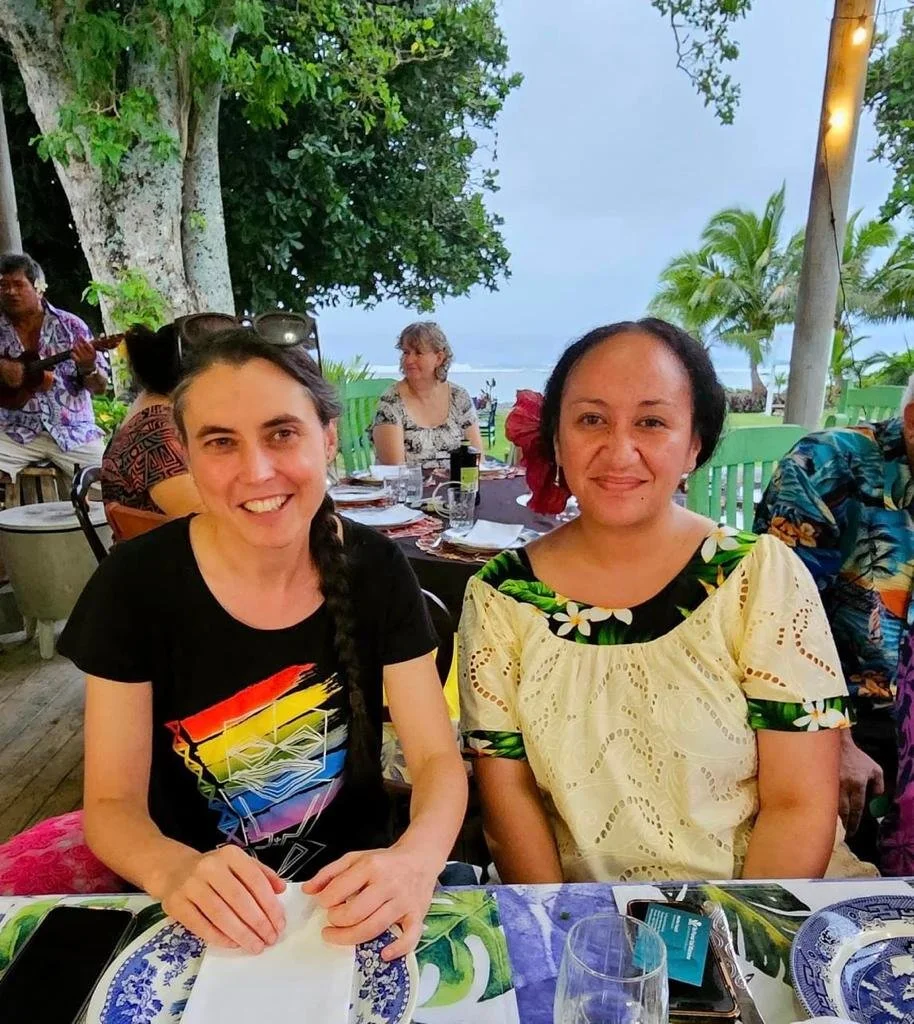
Lead researchers, Dr Akevai Nicholas, left (Ma’uke | Senior Lecturer, Waipapa Taumata Rau—University of Auckland) & Dr Emma Ngakuravaru Powell, right (Atiu & Mangaia | Director, Te Puna Vai Mārama; Adjunct Senior Lecturer, Ōtākou Whakaihu Waka—University of Otago).
The research will explore how ‘akapapa‘anga operates as a foundation for meaning-making, belonging and wellbeing, while examining the challenges many Cook Islanders face in maintaining these connections across an increasingly transnational world.
Over the past six decades, migration, depopulation and the decline of te au reo Māori have affected the ability of many Cook Islanders to engage with ancestral land, language and genealogical knowledge. While these issues are widely recognised within families and communities, there has been little research examining how these changes influence identity formation and everyday experiences of belonging.
Dr Powell said the project seeks to better understand why relationality remains so important to Cook Islands Māori life and what helps or hinders people in maintaining these vital cultural connections.
“‘Akapapa‘anga is more than a cultural value. It is a way of understanding how people are connected to one another, to their ancestors, to their land and to future generations. This project will help us better understand how those relationships continue to shape identity, meaning and wellbeing for Cook Islanders wherever they are in the world.”
A key component of the project will involve digitising selected Cook Islands records about land. By improving access to historical documents and genealogical information, the project aims to strengthen opportunities for people to reconnect with family histories, ancestral lands and cultural knowledge.
Alongside the digitisation programme, the research team will work with government agencies, community stakeholders and families to develop a co-designed governance framework and undertake a series of oral history interviews in both the Cook Islands and Aotearoa New Zealand.
The project will also investigate the critical role of te au reo Māori in preserving and interpreting genealogical knowledge, cultural responsibilities and relationships to land. Researchers will examine how language loss can affect access to cultural knowledge and explore ways to support its revitalisation through research and educational resources.
Expected outputs include an open-access scholarly book, a publicly accessible digital archive of selected documents related to land tenure, a collection of oral history recordings, and a series of open-access academic publications examining Pacific archival digitisation, language and cultural knowledge.
The research is expected to support future cultural and language education initiatives, contribute to curriculum development, and strengthen access to important cultural, legal and genealogical knowledge for Cook Islanders throughout the wider Cook Islands community.
For TPVM, the grant represents a significant investment in Indigenous Pacific-led research and highlights the centre's commitment to producing scholarship that is academically rigorous, community-centred and directly relevant to Pacific peoples.
The project will be undertaken in partnership with communities in the Cook Islands and Aotearoa New Zealand over the coming years, creating new opportunities for Cook Islanders to engage with their histories, language and ancestral relationships in meaningful ways.
Funding Acknowledgement
This project was made possible through the support of a grant from Templeton World Charity Foundation, Inc. (funder DOI: 501100011730) through grant https://doi.org/10.54224/35852. The opinions expressed in this publication are those of the author(s) and do not necessarily reflect the views of Templeton World Charity Foundation, Inc.